

What was this place we had commandeered…
New here? Start with the prologue || Read the blurb || Previous Chapter ←
As a small boy playing soldier, my fantasies had revolved around combat and war-making. When I and the other children staged our little wars, with tree branches for pikes and old washbuckets for helmets, we dreamt it was to avenge some queen who had been wronged, or to slay a giant ten headed beast. And so I was taken aback at the zeal with which Thod and the other troops, like common serfs, occupied and built up the savage settlement over the following days. I remarked on this to Ryzard and he laughed at me.
“Bloody hell, you are green. A soldier’s just a common laborer. Sometimes the labor is killing. Mostly it’s this” he said, gesturing at the wide trench the troops were digging around the entire settlement. They worked on it in shifts, so that the digging was constant day and night. When they finished it, it was deep enough for a grown man to fall in and be trapped.
The split rail fence posts around the camp were pulled out of the ground, and sharpened into deadly pointed stakes. These were stood upright and impaled at the bottom of the trench. Should the savages return to reclaim their home, they would be hard pressed to do so without falling in and goring themselves. We’d circled the wagons up within this perimeter as the soldiers began their digging, knocking down all of the mud dwellings in the process.
Despite these martial preparations, there was, at first, an air of calm about the men as the days progressed and our bones regained their padding; at last we had a larger future to think about than our own hunger. Once more the diplomats fell to arguing openly amongst themselves after weeks of sullen silence. Once more Ryzard was back to his endless prattling with anyone who could bear to listen, and even the Polemarch walked about with an ease I had not witnessed in him since before Abdera, as he supervised his men’s work. Providence alone had sent us back from across the line of starvation, into the world of the living.
No one, not even Ryzard, was willing to remark on the strangeness of our fortune. We had found a settlement flush with grain and devoid of people, exactly when we needed it. The soldiers were less spooked now, less prone to swearing oaths and praying to the imperial family, as they had done only a week ago. Yet a new feeling of unease was taking hold within me. What was this place we had commandeered?
With our stomachs full, we had time now to worry about such questions. Where had the savages, whose homes we’d trampled and whose meagre possessions we burned in a great bonfire, gone to? The younger diplomats darted their eyes in every direction when we broke to eat our meals together, fearful of an incursion from out on the plane. Surely our take over of this place would be noticed, and avenged.
“We ought to leave here, sir. We have the food we came for and we should continue on our way.” One of the diplomats said to the procurator, the same one who had argued with Ryzard upon our first sighting of the settlement, as they waited for me to weigh out their allotment of the breadgrain on the third day after the trench was finished. I tensed up, expecting the older man to swear at his charge the way he had at Ryzard, but he put his hand on the translator’s shoulder.
“It has been a hard journey, Poul. We all need rest. At least this patch of hellhole is fortified to keep us safe.” the procurator said, gently.
“We should not have destroyed their homes. Taking food is one thing. But what if they see us ruining their village as an act of war? What if they summon more of their stinking brethren to come here and– ”
“That is enough, Poul.” the procurator said sharply. “The soldiers will keep us safe and our journey will resume when the Polemarch says, not at your convenience. Remember your place, sirrah” the procurator told him as I ladled grain into his outstretched cup and he turned around without so much as acknowledging me.
Why had we destroyed the houses? I wondered. I could not stop thinking of the sigils within the hut of the bleeding walls. At times they still floated before me when I closed my eyes. That building had been trampled with all of the others. It was nothing but a cake of dried mud now. I would never know if what I had seen was delirium from hunger, or brought on by the hut’s stifling miasmas, as Ryzrd thought. Yet the feeling of the blood running down the walls and raining down on my head one drop at a time from the ceiling had been so real. The glowing emerald and ruby light of the sigils, though frightening, had also been beautiful.
There was a wrongness in what we do here, I thought. Not of diplomacy, as Poul claimed, but something deeper. We had destroyed a place that was, somehow, sacred. Something to do with the old gods. I found myself clutching at the sigil under my tunic regularly now. As though expecting to feel that pulsing, hot heartbeat within it once more. But it was only a coil of wire.
That night, I fetched the aspergillum from its hiding place within the wagon after the other men had retired for sleep. I set it and the sigil down next to each other within my tent and sat, staring at them. Expecting something to happen, either by virtue of my presence or from them being placed by one another. A priceless relic, sat next to a cheap twist of wire. I even whispered out several prayers I remembered in the old tongue, which I had learned when I was a boy across the sea. I did not recall if the words were a blessing, a prayer of intercession, or just a grace one says over food.
It mattered not, for whatever mysterious quality I had witnessed in both of these objects, I could not conjure forth. They had seemed so much more than cold metal and bone, and yet they were naught but this to all appearances. “Foolish superstitions” I muttered to myself as I put them away and went to sleep. The memory of the living signs and the bleeding walls still lingered on.
I had little to do now but brood on these mysteries. We ate almost nothing but the bread grain, which I doled out for each man every morning and night. I found myself suddenly restless.
Leery I might be conscripted to help with the soldiers’ brute labor, I took to wandering each day around the areas just outside of the settlement, to make myself scarce, and to alleviate my own boredom. After months of traveling each day, my own sense of normalcy had come to depend on momentum itself. I grew restive and irritable now when I stood still for long periods. Like certain fish that must swim or sink dead to the bottom of the sea, I had been turned into that oddest of creatures: an ambler.
When I had been younger, Baldwin always insisted on a long morning constitutional. He rose just after dawn most days, and walked about the docks and the houses of change, as though he were personally charged with knowing all business of the port. His face was always red and flushed on his return. I was a natural indolent and had never understood this need. Yet here I was, a man now suddenly hungry for movement.
At first, I walked in circles just out of sight of the trench, the sounds of the soldiers shovels and picks attacking earth were the only accompaniment to my steps. But as our days at the settlement wore on, I started picking a single cardinal direction each morning, and setting out right after breakfast rations were doled out, with a loaf of the flat bread to tide me over. I was walking beside a tiny, almost stagnant stream of water that ran east of the settlement, when I came across the pit.
Off in the distance from where I wandered I noticed what looked to be a rise in the otherwise perfectly flat plane, and journeyed towards it. As I approached, I saw a wide, short hill rising up before me. Above it, or rather on the other side of it I realized as I approached, were countless birds, the first I had witnessed in months. They wheeled about in a great flock. Circling something.
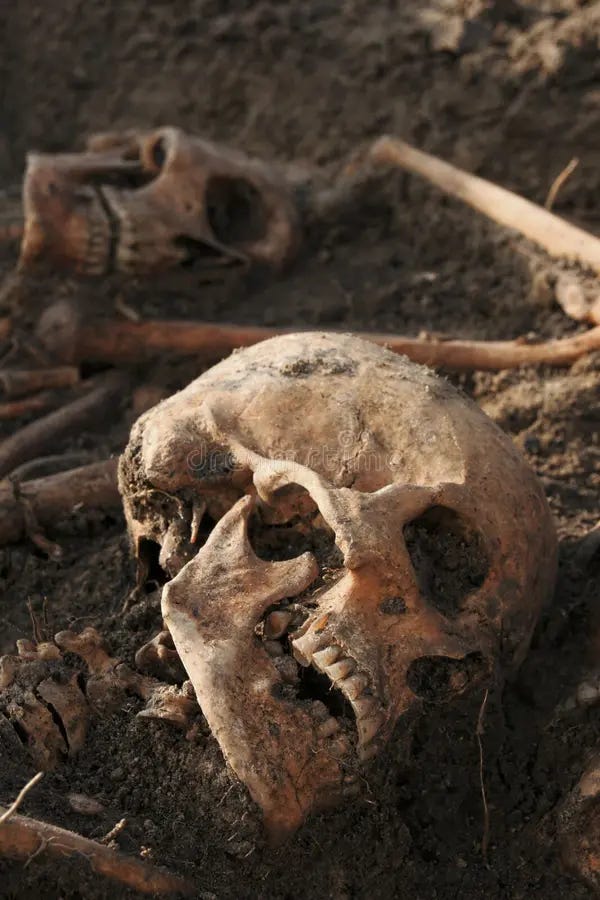
The day was cloudless and windless, and as I got closer the sounds of their shrieks drowned my hearing. I stopped at the base of the hill and turned around. I could see the smoke trails of the settlement camp fires, and the outlines of some of the wagons. I was not at a great distance, but should run into trouble, even without the birds and their awful din, I would not be heard. Going over the hill would put me completely out of sight of the others. I had grown accustomed to wandering, and there were no savages anywhere in sight, and the thought of returning to camp and having a shovel pressed into my hand was awful. What harm can it do? I am not so very far away. I walked up to the crest of the hill, and when I reached it and looked down, I saw the thing that had drawn the birds…
Alister’s journey continues
Subscribe to get new chapters every Thursday.